4 Practical Methods to Increase Daily Restaurant Customer Counts: Say Goodbye to Empty Tables
As a restaurant owner, I know your worst nightmare all too well: You have a fantastic kitchen, your service team is prepped, the mise en place is complete, and the lighting is perfect—but no one is walking through the door. Seeing your venue, which is impossible to book on weekends, turn into a ghost town on weekdays challenges both your motivation and your cash flow. Squeezing your entire restaurant customer traffic into just Friday and Saturday nights is, unfortunately, not a sustainable business model in the face of rising fixed costs.
So, is the problem your food? Most likely not. The problem usually lies in the invisible disconnect between the expectations of the potential restaurant customer and the experience you are currently offering, combined with a lack of making your voice heard. Years of experience in this industry have taught me one thing: Filling tables requires a strategy far more complex than just serving a delicious plate.
In this post, we will examine the operational dynamics you need to fix inside your four walls before attacking advertising budgets, and then how to shine that structure in the digital world. Our goal is clear: To position your business as the top choice in the mind of the restaurant customer, both physically and digitally.
Why "Just Good Food" Is No Longer Enough
There used to be a rule: "If you serve good food, the place will be packed." That rule no longer holds true on its own. The profile of the restaurant customer has evolved. Your guests are no longer going out just to feed their stomachs; they are going out to socialize, to feel good, and to be part of a story.
If you want to increase your daily restaurant customer count and fill those tables even on a slow Monday, you must first organize "the house" and then invite the guests. Here is that step-by-step strategy:
1. Menu Engineering and Creating "Perceived Value"
Many operators think that slashing prices is the right way to attract customers. However, this is a dangerous move that devalues your brand. In the psychology of the restaurant customer, "cheap" does not always mean "preferred." What draws a customer in and ensures they return is not the price, but the perception of "value."
You must structure your menu not just as a price list, but as a sales tool. When a restaurant customer sits at the table, they should feel guided and special through the menu's design.
- Signature Dishes and Storytelling: Every restaurant must have a "hero" product. But this product shouldn't just be tasty; it must be presented with a story. Instead of writing "Grandma’s Meatballs," describing it as "Chef’s signature grilled meatballs, prepared with a 24-hour rested special blend based on a childhood memory," creates curiosity in the restaurant customer's perception and significantly increases the likelihood of an order.
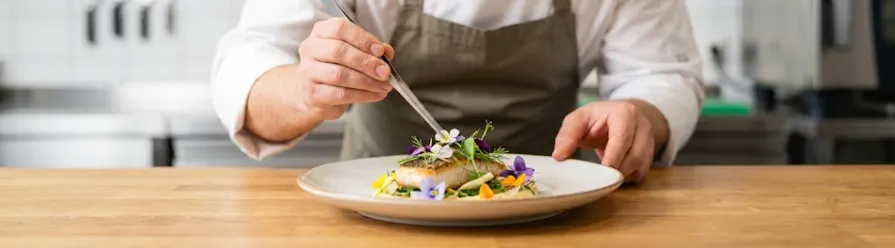
- Portion and Presentation Strategy: Visual satisfaction comes before physical satiety. Especially during lunch services or weeknight dinners, offering "Tasting Menus" or "Sharing Plates" allows the guest to try more variety while allowing you to maintain a healthy average ticket size.
Expert Tip: Ruthlessly eliminate the "Dogs" (low profit, low popularity items) from your menu. Simplifying the menu speeds up the restaurant customer decision-making process and streamlines kitchen operations, directly increasing service quality.
2. Managing the "Internal Customer": Staff Energy and Service Rhythm
There is a truth often overlooked in the sector: Unhappy staff creates unhappy customers. Your first and most important restaurant customer audience is actually your employees. A frown on a waiter’s face or a bartender’s reluctance can make even the world's best food taste bland.
Customer loyalty is built more on how they are treated than on the food on the plate. The phrase "Let's not go there, the staff is very surly" is a sinking signal for a business.
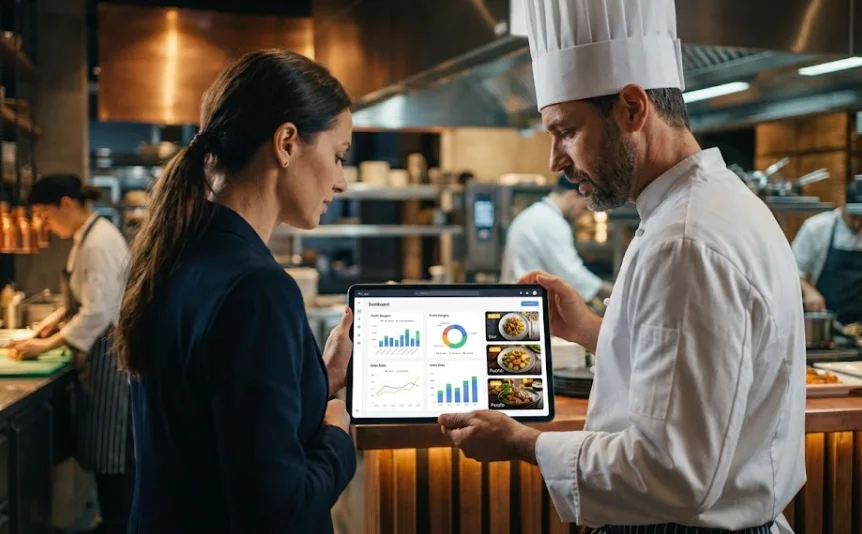
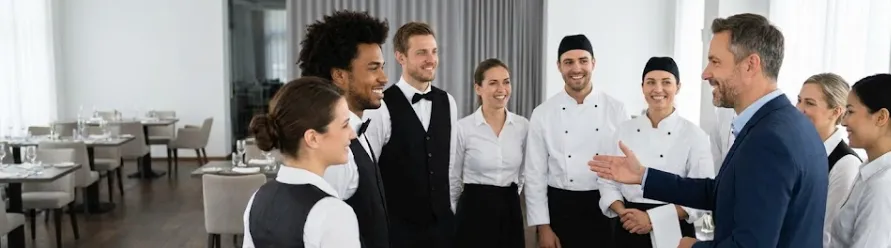
- Briefing Culture: Hold short 10-minute meetings before every service. Discussing the day's specials, expected reservations, and giving motivational speeches boosts the team's energy. A high-energy team elevates the restaurant customer experience by 100%.
- Sales Training: Do not view your team merely as "order carriers." They are your sales representatives. Teaching them to say, "Would you like to try our favorite wine of the month to pair with your meal?" instead of just "Do you want anything else?" increases revenue and gives the restaurant customer the feeling of receiving special attention.
3. Atmosphere Management and Reviving "Dead Hours"
The physical conditions of the restaurant directly affect the time a customer spends there and their desire to return. Lighting, music playlists, scents, and temperature... These are all parts of "neuro-gastronomy" and manage the subconscious of the restaurant customer.
The way to fill empty tables during the week is to transform the venue from a place where people just eat, into a place where people "spend time."
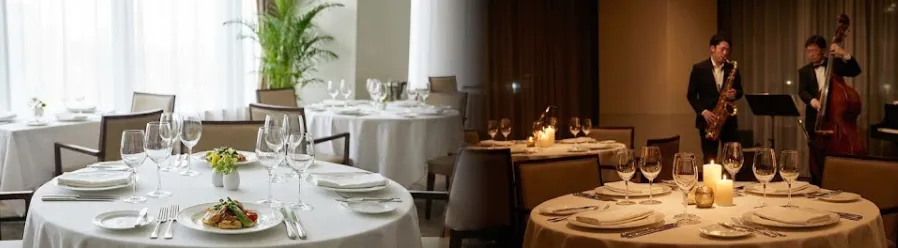
- Dynamic Atmosphere: Fast, energetic music and bright lights during lunch; warmer, dimmer lights and slow jazz tones in the evening... Changing the atmosphere according to the time of day allows you to host different restaurant customer profiles (e.g., business lunch diners vs. romantic dinner couples) in the same venue comfortably.
- Experience-Oriented Events: On your quietest days, like Tuesday or Wednesday evenings, offer a "reason" beyond just food. Events like "Pasta Making Workshop with the Chef," "Local Wine Tasting Night," or "Jazz Evening" attract a new segment of restaurant customer to your venue. These people might come just for the event that day, but if they have a great experience, they will return for a main course on a Saturday night.
4. Digital Showcase Management: Website, Social Media, and Marketing
We have arrived at the most critical link in the chain. You have a perfect menu, a great team, and a wonderful atmosphere. But who knows about it? If you are not "visible" in the digital world, you essentially do not exist for the potential restaurant customer.
Today, when people are hungry, they don't look at the street; they look at the screen in their pocket. Reflecting your internal operational excellence to the outside world is a prerequisite for modern management.
Your Website: Your Digital Castle
Your social media accounts can be shut down or algorithms can change, but your website is your property.
- Mobile Compatibility: 80% of restaurant customer searches are made on mobile devices. It is vital that your site loads fast, the menu is easy to read, and the "Book Now" button is at the very top.
- SEO (Search Engine Optimization): Including keywords like "Best Italian restaurant in [Neighborhood]" or "Breakfast spots near me" on your website puts you ahead of competitors in Google searches, driving organic restaurant customer traffic.
Social Media: Daily Interaction
Instagram and TikTok are like your daily newspaper.
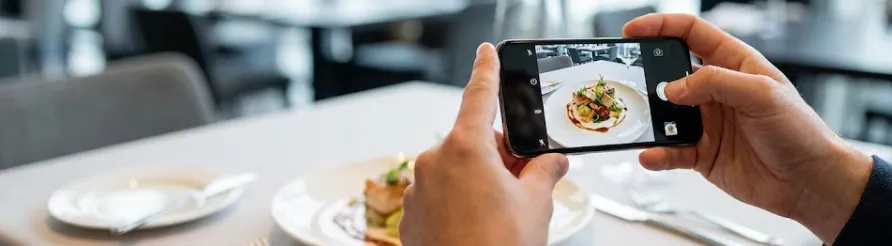
- "Live" Content: Don't just share professional studio photos. The chaos of the kitchen at that moment, a steaming fresh plate, or the team's preparation phase... This sincerity creates a feeling of "I need to be there right now" in potential restaurant customer candidates.
- User-Generated Content (UGC): Reposting your customers' shares shows that you value them and provides "social proof" to other potential customers.
Digital Marketing: The Targeted Shot
Instead of distributing traditional flyers, you can target people interested in food and beverage within a 3 km radius of your restaurant using Meta ads (Instagram/Facebook). A digital coupon like "Your dessert is on us just for today" can instantly change the restaurant customer traffic for that day.
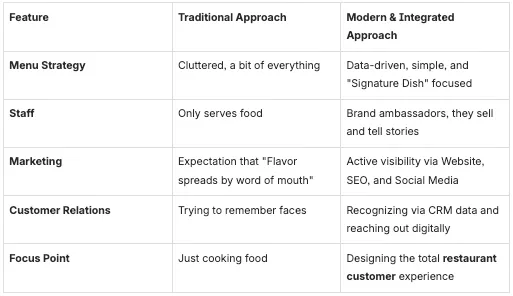
Traditional Management vs. Integrated Modern Approach
The table below clearly shows the difference between simply opening the doors and waiting versus proactive management, and its impact on restaurant customer numbers:
Conclusion: Time to Assemble the Pieces
As you can see, increasing the daily restaurant customer count is not achieved with a single magic wand, but by managing all instruments correctly like an orchestra conductor. The flavor in the kitchen, the smiling face in the dining room, the atmosphere in the venue, and your strong stance in the digital world... These are all gears that feed each other.
Running ads digitally without perfecting the internal operation is like pouring water into a leaking bucket. You must first secure the "inside" with the first 3 points above, and then invite the whole city to your table with the digital power in the 4th point.
As a business owner, your time is valuable. Managing all these processes manually can be difficult. However, when you take the right steps, you will see that restaurant customer loyalty and profitability increase significantly.
This is where FineDine becomes not just your digital menu provider, but your strategic partner in this new journey. Building that smart system that reflects the soul of your new restaurant, which your guests will love to use and which will lighten your operational load, is much easier than you think with FineDine.