What Is a Cloud Kitchen? The Complete Guide to Renting, Costs, and Running a Delivery-Only Kitchen in 2026
You have a killer recipe. Your friends cannot stop talking about your food. You dream of opening a restaurant, but you look at the rental prices, the interior design costs, the staffing requirements, and your motivation quietly fades. What if I told you there is a way to launch your food business without a dining room, without expensive decor, and with a fraction of the traditional startup cost?
Welcome to the world of cloud kitchens. Also known as ghost kitchens, dark kitchens, or virtual kitchens, this model has been reshaping the food and beverage industry since the pandemic accelerated delivery demand. And in 2026, it is no longer a trend — it is a proven, scalable business model that entrepreneurs around the globe are using to build profitable food brands from scratch.
Whether you are a first-time entrepreneur exploring your options or an established restaurant owner looking to expand without the overhead, this cloud kitchen guide will walk you through everything you need to know: what it actually is, how much it costs, how to set one up, and how to avoid the most common mistakes.
How Does a Cloud Kitchen Actually Work?
A cloud kitchen is a professional food preparation facility designed exclusively for delivery orders. There is no storefront, no tables, no waitstaff. The entire operation revolves around receiving online orders, preparing food efficiently, and handing it off to delivery drivers.
Think of it as the backstage of a restaurant, without the stage itself.
Here is the typical flow: A customer places an order through a delivery platform or your own online ordering system. The order reaches your kitchen display or printer. Your team prepares the meal. A courier picks it up and delivers it to the customer. Simple, clean, and remarkably cost-effective.
The beauty of this model lies in its flexibility. A single cloud kitchen facility can house multiple restaurant brands simultaneously. You could run a burger brand, a poke bowl concept, and a dessert line — all from one kitchen, all under different brand names, all targeting different customer segments through different delivery apps.
Why Cloud Kitchens Are Booming in 2026
The numbers speak for themselves. The global cloud kitchen market was valued at approximately $65 billion in 2024 and is projected to surpass $120 billion by 2030. But what is really driving this growth?
Consumer behavior has permanently shifted. The convenience of food delivery is no longer a luxury — it is an expectation. According to industry research, over 60% of consumers order delivery at least once a week, and this percentage continues to climb in urban areas.
Operational costs are lower. Running a traditional restaurant means paying for prime real estate, furniture, decor, front-of-house staff, and utilities for a large space. A cloud kitchen strips all of that away, letting you focus your budget on what actually matters: food quality, packaging, and marketing.
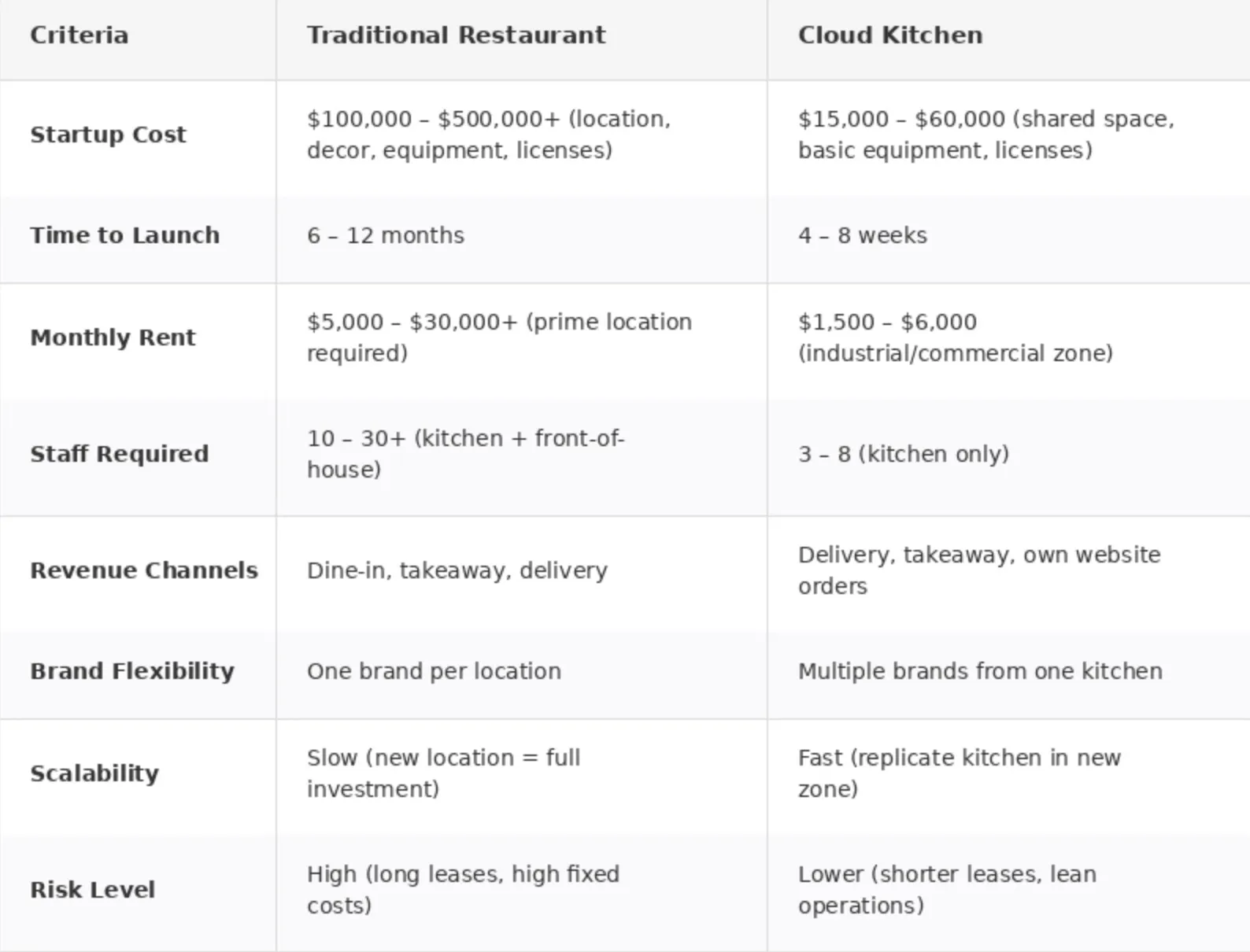
Speed to market is unmatched. You can go from concept to taking orders in as little as 4 to 6 weeks. Try doing that with a traditional restaurant and you are looking at 6 to 12 months, at minimum.
Cloud Kitchen vs. Traditional Restaurant: A Side-by-Side Comparison
Before you make your decision, it helps to see the two models next to each other. The table below highlights how a cloud kitchen stacks up against a traditional dine-in restaurant across the metrics that matter most:
How Much Does It Cost to Rent a Cloud Kitchen?
Let us talk numbers, because that is what ultimately determines whether this model works for you. Cloud kitchen rental costs vary significantly based on location, facility type, and services included.
Shared Cloud Kitchen Spaces
This is the most popular option for newcomers. Companies like CloudKitchens, Kitchen United, and various local providers offer turnkey kitchen stations that come with equipment, ventilation, and sometimes even packaging supplies. Monthly rent typically ranges from $1,500 to $4,000 per station, depending on the city and included services.
Private Cloud Kitchen Rentals
If you need more space or want complete control over your environment, renting a standalone commercial kitchen is the way to go. Expect to pay anywhere from $3,000 to $8,000 per month, plus utilities and maintenance. You will also need to invest in your own equipment if the space comes unfurnished.
Build Your Own
For established operators with capital, building a dedicated cloud kitchen from scratch offers maximum control. Initial investment ranges from $30,000 to $100,000, but the long-term unit economics can be very favorable if you plan to run multiple brands or operate at high volume.
Pro Tip: Before signing any lease, check whether the facility meets your local food safety and health department regulations. A cheap kitchen that cannot pass inspection will cost you far more in the long run.
5 Steps to Launch Your Cloud Kitchen Successfully
Getting started does not have to be overwhelming. Here is a practical, step-by-step approach that I have seen work time and again in this industry:
Step 1: Define Your Concept and Target Market
Do not try to be everything to everyone. The most successful cloud kitchen brands are highly focused. Pick a cuisine, define your ideal customer, and build your menu around dishes that travel well. Remember, food needs to look and taste great after a 20-minute delivery ride — not just when it leaves the pass.
Step 2: Secure Your Kitchen Space
Visit multiple facilities. Check the equipment condition, ask about shared cold storage, understand the cleaning schedules, and negotiate your lease terms. Pay attention to the location relative to your target delivery zones — a kitchen 30 minutes away from your customers defeats the purpose.
Step 3: Build Your Digital Presence
This is where many operators stumble. You have no physical storefront, so your entire brand exists online. Your menu needs mouth-watering photos, clear descriptions, and strategic pricing. Your online ordering page needs to be fast, mobile-friendly, and easy to navigate.
This is exactly where a tool like FineDine becomes essential. With FineDine's AI-powered menu builder, you can upload your food photos and generate a professional, multilingual digital menu in minutes. No design skills needed. And since your menu is your only storefront, making it visually compelling is not optional — it is everything.
Step 4: Set Up Your Operations
Standardize your recipes, train your team on consistency, and implement a reliable order management system. Every minute counts in a delivery operation, so your workflow needs to be tight. Track your prep times, monitor your packaging quality, and establish clear handoff procedures with delivery drivers.
Step 5: Launch, Measure, Iterate
Go live on delivery platforms, promote your launch through social media and targeted ads, and start collecting data immediately. Which items sell best? What is your average preparation time? Where are the bottlenecks? The operators who treat data as a daily habit — not an afterthought — are the ones who survive and scale.
Common Mistakes That Kill Cloud Kitchens
I have watched many promising cloud kitchen concepts fail, and the reasons are usually the same. Avoid these traps:
Ignoring packaging quality. Your food has to survive transit. Invest in proper containers that keep hot food hot, cold food cold, and presentation intact. Soggy fries and collapsed burgers generate one-star reviews faster than anything else.
Spreading too thin, too fast. Launching five virtual brands on day one sounds exciting until you realize your kitchen cannot handle the complexity. Start with one or two concepts, perfect them, and then expand.
Neglecting your own ordering channel. Relying solely on third-party platforms means paying 25 to 35 percent commissions on every order. Build your own online ordering system early. Even a 10 percent shift from platform orders to direct orders can dramatically improve your margins.
Skipping menu engineering. Not every dish belongs on a delivery menu. Analyze your food costs, portion sizes, and delivery compatibility. Remove items that travel poorly or have thin margins. Focus on your high-profit, high-popularity items — your "Stars" in menu engineering terms.
The Digital Backbone: Why Technology Makes or Breaks Your Cloud Kitchen
Running a cloud kitchen without the right technology is like trying to navigate without a map. You need a digital infrastructure that handles menu management, order flow, and customer engagement seamlessly.
Your digital menu is especially critical. Unlike a traditional restaurant where a waiter can describe dishes and make recommendations, your menu has to do all the selling on its own. High-quality photos, appetizing descriptions, allergen information, and smart categorization are not nice-to-haves — they are revenue drivers.
With FineDine, you get an AI-powered platform that handles your digital menu, builds your online ordering website, and provides the analytics you need to make data-driven decisions. Whether you are running a single cloud kitchen or managing multiple virtual brands, having one centralized system to manage your menus across all channels saves time, reduces errors, and keeps your operation agile.
Conclusion: Is a Cloud Kitchen Right for You?
The cloud kitchen model is not a shortcut — it is a different path. It requires the same passion for food, the same commitment to quality, and the same entrepreneurial grit as any restaurant. What it removes is the unnecessary financial burden of a traditional setup.
If you have a strong food concept, a clear understanding of your target market, and the willingness to embrace digital tools, a cloud kitchen might be the smartest move you make this year. The barrier to entry has never been lower, and the demand for delivery has never been higher.
Start by defining your concept. Research kitchen spaces in your area. And build your digital presence from day one — because in the cloud kitchen world, if you are not online, you simply do not exist.
Ready to build the perfect digital menu for your cloud kitchen? FineDine's AI-powered menu builder lets you create a stunning, multilingual online menu in minutes. Start your free 14-day trial today.