Menu Guide for New Restaurant Owners: Balancing Taste and Experience
Imagine the moment you finally open your restaurant’s doors. The decor you chose with such care, the excitement of your team, and those inviting aromas wafting from the kitchen... But when your guest finally sits at the table, the real hero that whispers your restaurant's story to them is the menu.
Today, creating a menu isn't just about listing dishes; it’s about guiding the guest, showcasing your kitchen's talents correctly, and ensuring your business survives. As an expert in digital transformation in the F&B sector, I’m here to tell you how technology and data can be your most elegant companions on this journey.
Here are the ways to establish that crucial "balance" that both protects your business and delights your guests, all within this comprehensive menu guide for new restaurant owners.
1. Foundations of Menu Planning: Matching Story and Expectations
Every successful restaurant has a soul. Your menu is that soul poured onto paper (or a screen). To build the right bond with your guests, you must back up your intuition with data.
Concept and Guest Profile Analysis
The best menu is born at the intersection of your chef’s skills and your guest’s desires. When creating a menu guide for new restaurant owners, the most critical step is understanding exactly who you are speaking to.
- Know Your Guest: Is your restaurant a spot for a quick lunch break, or a destination for a long, leisurely dinner? This answer determines the number and variety of items on your menu.
- Monitor Feedback: What do guests love at similar restaurants nearby, and what do they criticize? Reviews in the digital world provide you with amazing clues about guest expectations.
- The Elegance of Simplicity: Complex, multi-page menus exhaust your kitchen team and make it hard for guests to decide. Offering fewer but better options—dishes that are truly signature—is always more reassuring.
Balance in the Menu: Menu Engineering
Menu engineering is essentially the art of connecting the guest with the dishes they will enjoy most. Thanks to digital POS systems, you can see which items are loved and which are fading into the background.
You can evaluate your dishes in four categories to keep your menu fresh:
- Stars: Items that are both popular and highly profitable. These are the lead actors of your menu.
- Puzzles: Dishes that are high profit but low popularity. Perhaps you just need to change the name or the photo to grab the guest's attention.
- Plowhorses: Very popular items with lower profit margins. Focus on how you can make the preparation process more efficient here without sacrificing quality.
- Dogs: Items that are unpopular and low profit. Don't be afraid to remove these from the menu and replace them with fresh, seasonal excitement.

2. The Comfort of Digital Transformation and Automation
Technology doesn't mechanize your restaurant's soul; on the contrary, it frees up your team to spend more time with guests. In any modern menu guide for new restaurant owners, digitalization is essential for a flawless service flow.
Staying Dynamic and Current (QR Menus)
If you use seasonal products or face supply chain disruptions, digital menus are lifesavers.
- Transparency and Accuracy: Let’s say you couldn't find fresh sea bass today. Thanks to digital menu integration, you can instantly hide the unavailable item. This way, you don't have to embarrassingly tell the guest "sorry, we're out" during the order; you enjoy the confidence of always offering what is "available."
- Visual Appetite: The human brain decides with visuals. On digital menus, you can clearly display the most appetizing photos of your plates, detailed ingredients, and even allergen warnings.
The Guidance of Data
Automation systems allow you to understand guest habits. With data like "Breakfast traffic spikes on Sunday mornings," you can design set menus or practical options specific to those hours to speed up service. This prevents service bottlenecks and increases guest satisfaction.

3. Sustainability and Standard Taste (Recipe Management)
When a guest visits your restaurant a second time, they want to find that same great taste they had the first time. Recipe management is the key to maintaining this standard.
Standard Recipes for Consistency
Kitchen automation software ensures that the flavor formula determined by your chef remains the same in every single plate.
- Flavor Guarantee: Having recipes recorded digitally ensures the plate comes out with the same standard, regardless of who is in the kitchen.
- Preventing Waste: Correct portioning and stock tracking minimize food waste. This is critical for both respecting nature and your business's health.
- Fair Pricing: Knowing the true cost of a plate allows you to correctly determine the value you offer the guest. The price must be proportional to the quality and service provided.
Menu Design and Perception
How prices are presented on the menu determines the guest's focus. Within the scope of this menu guide for new restaurant owners, an aesthetic presentation is highly recommended:
- Focus on Flavor: Avoid using currency symbols too dominantly or writing prices in huge fonts. This ensures the guest focuses on the ingredients and the promise of flavor rather than the cost.
- Price Diversity: Having accessible options alongside "signature" dishes suitable for special celebrations makes guests of all budgets feel comfortable.

4. Design and Flow: The Eye's Journey
Menu design should make the selection process easy and enjoyable for the guest. Instead of a complicated list, you must offer a well-structured flow.
The Art of Highlighting
Guests usually scan the menu rather than reading it word for word.
- Chef's Recommendations: Position your most trusted, fresh, and signature dishes in the most attention-grabbing areas (usually the middle or top right corner). This is a safe harbor for the undecided guest asking, "What should I eat?"
- Appetizing Descriptions: Instead of writing "Grilled Chicken," saying "Charcoal Grilled Chicken Marinated with Fresh Mountain Thyme" visualizes the dish in the guest's mind and starts the experience right at the moment of ordering.

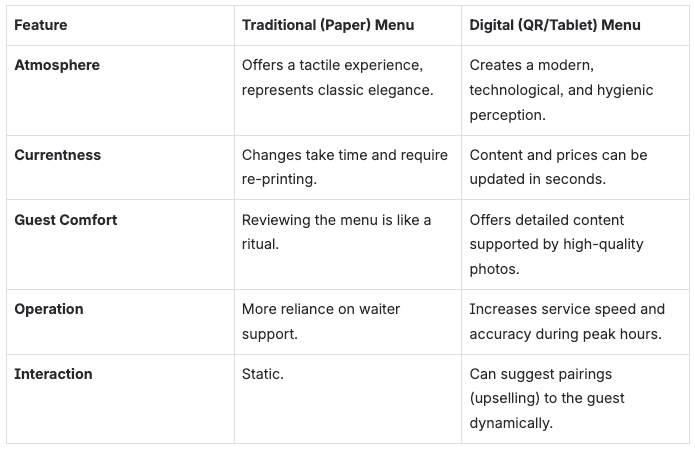
Harmony of Traditional and Digital
The table below summarizes what each format offers you and your guest in the context of a menu guide for new restaurant owners:
5. Seasonality and Naturalness
In modern restaurateurs, the greatest luxury is freshness. Updating your menu according to seasonal cycles is the most elegant way of telling your guest, "We serve the freshest food."
Thanks to the flexibility of digital menus, you can instantly add pumpkin flavors in winter or refreshing options in summer. This dynamism shows that your restaurant is a living entity that follows nature.

Conclusion: The Menu is Your Signature
To wrap up, this menu guide for new restaurant owners is not just a set of rules, but a roadmap. Your menu is the balance between your passion for flavor, your hospitality, and your business acumen.
There is no perfect menu; there is a living and evolving menu. Our goal is not just to make a profit; it is to create happy guests, a satisfied team, and a delightful business that lives on for years. Automation and digitalization will save you time on this journey; and you will dedicate this time to looking into your guests' eyes and saying, "Welcome."
So, how does managing all these strategies—from dynamic pricing to appetizing visuals, from instant stock management to data-driven menu engineering—from a single place, effortlessly, sound to you?
This is where FineDine becomes not just your digital menu provider, but your strategic partner in this new journey. Building that smart system that reflects the soul of your new restaurant, which your guests will love to use and which will lighten your operational load, is much easier than you think with FineDine.