You want to hear from guests, and nobody fills in thirty questions between the main course and the bill. So send five: one overall rating, one about coming back, two about whatever you changed this month, and one open box for the thing you didn't think to ask. The other questions here are the pool you draw from, grouped by the part of the visit they cover, with reservations and takeout included because most templates leave them out.
Which five questions to send this month
Send five at a time and save the rest for later months. A guest tapping through a form on their phone before the bill comes will give you a minute, maybe less, and five questions is about what fits.
- One overall rating on a 1 to 5 scale (question 1). Keep the wording identical every month, or this month's score can't be compared with last month's.
- One return question (question 3). On a short form it's the closest you get to asking whether the visit was worth the money.
- A first question from the area you changed. New specials board? Take it from the food group. New floor manager? Take it from service.
- A second question from the same area, preferably one with fixed answers rather than a text box.
- One open question at the end (question 5), marked optional.
Pick one scale and use it across the whole form. Mix 1 to 5 with 1 to 10 and you end up with numbers you can't put side by side.
Questions about the visit as a whole (1 to 5)
These stay on the form month after month. The answer format is in brackets.
- Overall, how would you rate your visit today? (1 to 5)
- Was this your first visit, or have you been before? (First time / Been before)
- How likely are you to come back or order from us again? (1 to 5)
- What was the best part of your visit? (Open)
- If you could change one thing about tonight, what would it be? (Open, optional)
Don't skip question 2. A regular and a first-timer who both give the same dinner a 3 aren't saying the same thing, so split the results by this answer before you read anything else.
Questions about the food (6 to 11)
Food questions work best when they point at a specific plate, or at something the menu promised.
- How would you rate the food you ordered? (1 to 5)
- Did your dish arrive the way the menu described it? (Yes / No, with a comment box)
- How was the portion for the price? (Too small / About right / Too big)
- Which dish would you order again? (Open, or a list of this month's dishes)
- If you have a dietary restriction, did we accommodate it? (Yes / No / Not applicable, with a comment box)
- How is the range of options on our menu? (Too few / Just right / Too many)
Question 8 is the one most likely to end up in a costing meeting. Before you change a recipe over it, check how fast that ingredient moves through your storeroom. Our piece on inventory turnover ratio walks through the calculation.
Questions about the service (12 to 17)
Ask a guest to rate the service and you get a mood. These questions ask about moments instead: the wait at the door, the time until the food came, the end of the meal.
- How would you rate the service today? (1 to 5)
- How long did you wait to be greeted or seated? (Under 5 minutes / 5 to 10 minutes / Over 10 minutes)
- Did your food come out in a reasonable time? (Yes / No)
- Could your server answer your questions about the menu? (Yes / No / Didn't ask)
- If something went wrong, did your server sort it out? (Yes / No / Nothing went wrong, with a comment box)
- Were you offered dessert or coffee at the end of the meal? (Yes / No)
Answers to 13 and 14 only mean something once you know when the visit happened. A slow Friday at 8 pm and a slow Tuesday lunch are different problems. The first points at how the peak is staffed, and the second may be a training gap. If the answers keep coming back to the floor, our guide on how to be a good restaurant manager covers the part of the job these questions measure.
Questions about the room (18 to 21)
- How comfortable was your table? (1 to 5)
- How was the noise level? (Too quiet / About right / Too loud)
- How was the temperature in the room? (Too cold / About right / Too warm)
- Would you bring someone here for a special occasion? (Yes / Maybe / No)
Question 21 gets at the room without asking about decor. When guests answer No here and still rate the food a 5, the plate may be ahead of the space.
Questions about booking and takeout (22 to 27)
Most survey templates stop at the dining room. If you take bookings or send food out, part of the guest's experience happens before they sit down or after the bag leaves, and these six cover it.
- How easy was it to book a table? (1 to 5)
- Was your table ready at the time you booked? (Yes / No, I waited)
- How did you book? (Phone / Online / Walk-in / Other)
- Did your order arrive complete? (Yes / No, with a box for what was missing)
- How was the food on arrival compared with eating in? (Better / Same / Worse / Never eaten in)
- Was the delivery or pickup time what you were told? (Yes / No)
Send 25 to 27 only to takeout and delivery guests, never on the dine-in form. If delivery is taking a bigger share of your orders, our piece on online ordering for restaurants covers the setup decisions behind questions 25 and 27.
Questions about the digital menu and payment (28 to 30)
- If you ordered from the menu on your phone, how easy was it? (1 to 5)
- Could you find what you were looking for on the menu? (Yes / No, with a comment box)
- If you paid from your phone, how did it go? (1 to 5, with a comment box)
Only ask these of guests who used the phone menu or paid from their phone. Someone who ordered from a server and paid by card at the till has nothing to rate here, and if the form makes them answer anyway, a guessed 3 lands in your average.
Reading survey answers against the 30/30/30/10 split
The 30/30/30/10 rule is a rough budgeting split some operators plan with: about 30% of revenue to food and drink cost, 30% to labor, 30% to everything else (rent, utilities, marketing, software), and 10% left as profit. It's planning shorthand, not a benchmark. A bakery, a bar and a fine dining room split their money very differently, and your own P&L is the number that counts.
For surveys it earns its place for one reason. Read a complaint and you can usually tell which line the fix would come out of.
Take question 8. If "too small" keeps coming back, a bigger portion raises food cost, while rewriting the menu description or adjusting the price doesn't. If question 13 shows guests waiting over 10 minutes on Friday nights, look at the shift schedule before anyone talks about hiring. Both sit on the labor line. If question 19 says too loud, the fix lives in overhead: soft furnishings, a different playlist, fewer tables in one corner.
Any fix that isn't priced into one of the three cost lines comes out of the 10%. So before you act on a survey trend, name the line that will pay for it.
What a restaurant survey can't tell you
A survey only hears from guests who chose to answer. The guest who quietly decided not to come back isn't in the results, and no question on the list will reach them.
One harsh comment is a lead, not a trend. Wait until the same complaint turns up across several weeks before you change a recipe or a rota, and check it against the time and channel of the visits it came from.
Incentives change who answers. A free dessert for finishing the form brings in guests who wouldn't otherwise bother. That's useful, but it also means a month with the incentive and a month without it can't be compared.
Nor can a survey explain why someone didn't book or didn't order. That answer is in your sales and menu data, not in the comment box.
Collecting the answers from the menu guests already hold
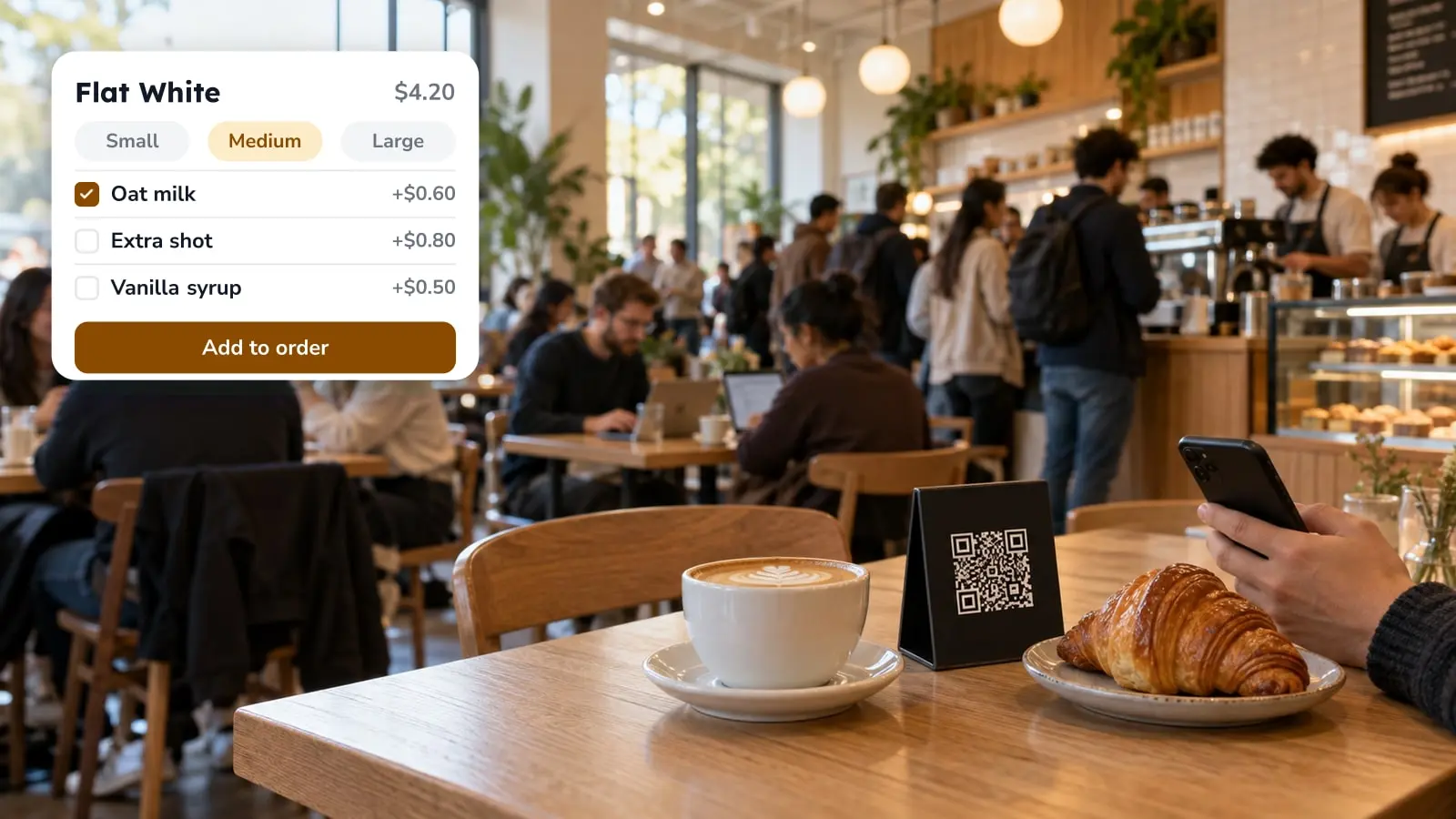
If your menu runs on FineDine, the survey lives in the same panel as the menu. Feedbacks, under Guests & Engagement, holds the forms you build and the results that come in. Guests reach the form from a feedback button on the welcome page of the digital menu, so they answer on their own phone at the table while the meal is still fresh, not in an email three days later. Our piece on what changes after a guest scans the QR code covers the rest of that screen.
Survey text is translated in Translation Center, on a Surveys tab next to menus and modifiers, within the languages your plan includes. The pricing page lists how many that is for each plan.
FineDine IQ has a Feedbacks tab next to Sales and Menu Performance. On Monday morning you can read Friday's service answers and then check Friday's orders one tab over. Guests can also rate individual dishes on the item page of the menu, which answers question 9 without anyone filling in a form.
| Budget line (rough share) | Survey questions that point to it | What a fix usually touches |
|---|---|---|
| Food and drink (about 30%) | 6, 7, 8, 9, 10, 11, 26 | Portion size, recipe, supplier, menu range, packaging for delivery |
| Labor (about 30%) | 12, 13, 14, 15, 16, 17, 23, 25, 27 | Shift schedule, training, station setup, order checking before dispatch |
| Overhead (about 30%) | 18, 19, 20, 22, 24, 28, 29, 30 | Room layout and furnishings, booking setup, digital menu, payment setup |
| Profit (about 10%) | 1, 2, 3, 4, 5, 21 | No fix lives here. Any fix not budgeted in the lines above comes out of this one |
Frequently Asked Questions
- How often should I change the questions on my restaurant survey?
- Keep the overall rating and the return question fixed so the months stay comparable. Swap the other three when your focus moves, say after a menu change, a new hire on the floor or the start of delivery.
- Is a 1 to 5 or a 1 to 10 scale better for a restaurant survey?
- Either works if you stick with it. A 1 to 5 scale gives guests fewer options to tap on a small screen, which suits a form filled in at the table. Switch scales later and you lose the comparison with every month before.
- Can I run the same survey in Spanish or other languages?
- Yes, as long as each translation keeps the same meaning and the same answer options, so the results can be added together. On FineDine, survey text is translated in Translation Center on the Surveys tab, within the menu languages your plan includes.
- Should I reply to guests who leave a negative survey answer?
- If the guest left contact details and the problem is specific, send a short reply saying what you checked. Treat the answer itself as one data point until the same complaint comes up again.